
What is a Palatal Expander and Does My Child Need One?
What Is a Palatal Expander and Does My Child Need One?
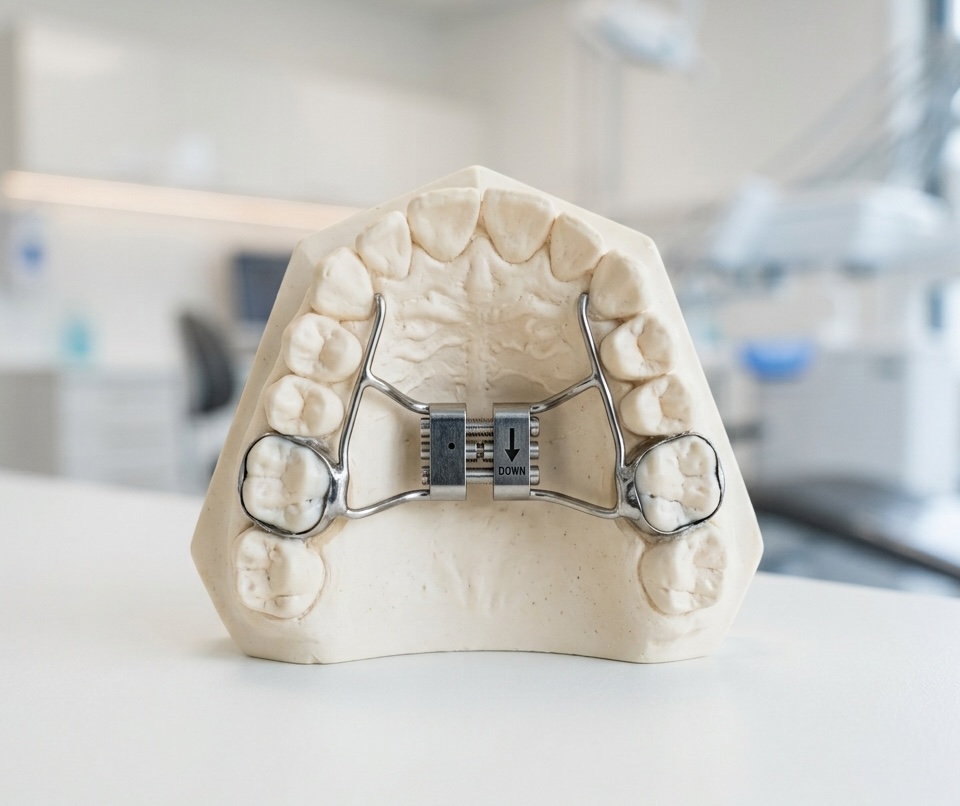
A palatal expander is a small custom appliance that gently widens your child's upper jaw to correct crossbites, crowding, and narrow arches while the jaw is still growing. Not every child needs one, but for kids who do, treating it earlier is far simpler than treating it at 25.
What Is a Palatal Expander?
An expander is a device that sits against the roof of the mouth (the palate) and attaches to the upper back teeth. Some expanders are adjusted by turning a small screw to gradually widen the upper jaw, while others use built-in springs or wires and require no turning at all. American Association of Orthodontists
Here's the part most parents don't know: in a growing child, the two halves of the upper jaw haven't fused yet. Expansion works by stretching the growth suture in the middle of the palate so the two halves move apart, and as they separate, new bone fills in. That's why timing matters so much. If it isn't corrected while growth remains, widening a narrow palate in adulthood may require surgery. (AaoinfoAaoinfo)
The American Association of Orthodontists has a helpful overview on what a palatal expander is and what it's used for, and the ADA's MouthHealthy covers the basics of orthodontic treatment if you want a second trusted source.
Signs Your Child Might Need One
Expanders are typically recommended for:
- Crossbite — upper back teeth biting inside the lower teeth
- Severe crowding — not enough room for permanent teeth to erupt
- Impacted teeth — usually canines, blocked from coming in
- A narrow, high, or V-shaped palate
- Chronic mouth breathing — when paired with a narrow upper arch
If any of these sound familiar, our post on 5 signs your child may need to see an orthodontist soon is a good next read.
How Long Does It Take?
Active expansion (the turning phase) usually takes two to four weeks. After that, the expander stays in place for several months while new bone fills in and stabilizes the result. Total wear time is commonly 6 to 9 months.
Most kids feel pressure, not pain. There's a lisp for the first week, some extra drooling, and a temporary gap between the front teeth that almost always closes on its own. Expanders are frequently part of Phase 1 interceptive orthodontics, and many children still need braces or Invisalign later to finish aligning the teeth.
A Word From Your OrthodonTish
A common question in my office is: "Is an expander really necessary?" My honest answer: Sometimes yes and sometimes no.
What I won't do in my practice is watch a narrow upper jaw and a crossbite and say nothing because the child is "too young." A crossbite left alone doesn't resolve itself. It can wear the enamel down unevenly, can shift the lower jaw off-center as the face grows, and turns a six-month appliance into an adult surgical case. I've seen it, and it's avoidable.
I also don't recommend expanders reflexively. Plenty of kids who come through my door in Mount Laurel with crowded teeth do not need one, and I say so. As a board-certified orthodontist, I'd rather monitor a child for two years for free than start treatment a year too early.
Dr. Tish Henderson, Board-Certified Orthodontist, Amazing Brace Orthodontics, Mount Laurel, NJ
Frequently Asked Questions
At what age should my child be evaluated for an expander?
The AAO recommends every child see an orthodontist by age 7. Expanders work best roughly between ages 7 and 12, before the palatal suture fuses. More on that in our post on the "Age 7" ortho rule.
Does a palatal expander hurt?
No. Most children describe pressure or tightness for a few minutes after each turn. Discomfort is generally milder than the first week of braces.
Do I have to turn the key myself?
For screw-type expanders, yes usually once a day at home. We show you exactly how at the appointment and you'll practice with us before you leave.
Will my child talk funny?
Briefly. Speech normalizes within about a week as the tongue adapts. Reading out loud for a few minutes each night speeds it up.
Can adults get a palatal expander?
Results are limited once the suture fuses. Adults often need surgically assisted expansion instead, which is exactly why we treat this early.
Is it covered by insurance?
Often, at least partially, under orthodontic benefits. We verify coverage before you commit to anything. See our breakdown of braces and Invisalign costs in Mount Laurel.
Consultations at Amazing Brace Orthodontics are complimentary. We're at 4200 Dearborn Circle, minutes from Route 38 and I-295, serving families in Mount Laurel, Moorestown, Marlton, Cherry Hill, Voorhees, and Medford. Here's what to expect at your first appointment, or call (856) 242-2126 to book.

Expert care, compassionate approach